|
|
|
|
Page Views: 3,635 |
| All about the color of Foundation (double-infrared, or brown if that's easier for you to picture). |
| Estimated reading time: 5 minute(s) (984 words) |
The Color of Foundation

To understand the mechanisms working here, let's look at the science behind colors.
Colors
One reason the Hindus recognized the chakra system as being composed of seven levels
is that they could see seven colors. Since then, research has shown that the
number of colors Humans perceive in a rainbow is exactly the number of colors
they have primary names for! A couple of African tribes, for example, have names for
only two colors ("warm" and "cool") and perceive just those two colors in a rainbow,
though their eyes are built just like anybody else's.
Primary colors are composed of light vibrating at specific frequencies. The highest
visible frequency (and, therefore, shortest wavelength) is violet; the lowest visible
frequency (and, therefore, longest wavelength) is red.
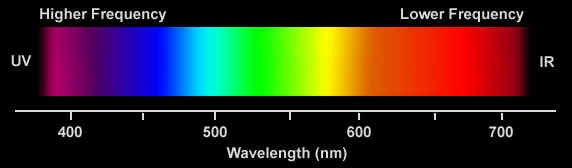
The invisible colors
above violet, we call ultra-violet; the invisible
colors below red we group as infra-red.
We determine frequency via the following formula:
where Velocity is the speed of light (2.997925 x
10+8 meters per second).
Although the colors do not take up even spaces on the spectrum—we perceive a
wider range as "red" than we do "yellow"—If we accept a "red" wavelength of 675
nm, and place each successive color just 50 nm lower, we wind up with the following
colors and frequencies:
|
Color |
Wavelength |
Frequency |
|
Red |
675 nm |
444,137.04 GHz |
|
Orange |
625 nm |
479,668.00 GHz |
|
Yellow |
575 nm |
521,378.26 GHz |
|
Green |
525 nm |
571,033.33 GHz |
|
Blue |
475 nm |
631,142.11 GHz |
|
Indigo |
425 nm |
705,394.12 GHz |
|
Purple |
375 nm |
799,446.67 GHz |
The Hindus who developed the seven-level chakra system, quite clearly saw
red as the color of the first chakra (which, in ONA, corresponds to System
Three). That's why they developed a seven-level system: Even though they could
sense the energy of the first and second Systems, because they did not radiate in a way
that corresponded to a color in the visible spectrum, the Hindus relegated these
Systems to the realm of "minor chakras". (They actually ascribed "deep reds" to the
lower chakras, certainly an accurate way of describing infra-red.)
But, now we know that light doesn't have to be visible to be real. We can extend the spectrum
as needed to represent as many chakras, centers or Systems as we want, with the
understanding that there will not be simple, visible, Crayola-style colors for the
additional Systems.
The actual color of Foundation, then, is double infra-red—that is, its
wavelength is 100 nm less than red.
Unfortunately, our eyes are not constructed to perceive this color. We can sense it
as warmth or heat, but as a color it is invisible for the most part. Some people can
envision it, just the same, if they have a lot of experience working with the visible
spectrum. You can make use of handy substitutes for the invisible colors,
effects rather than colors, effects that have psychological connotations related
to the System to which we've assigned them:
|
System |
Name |
Color |
Wavelength |
Frequency |
|
1 |
Foundation |
Ground |
775 nm |
386,829.03 GHz |
|
2 |
Acknowledgement |
Bronze |
725 nm |
413,506.90 GHz |
|
3 |
Connection |
Red |
675 nm |
444,137.04 GHz |
|
4 |
Mobility |
Orange |
625 nm |
479,668.00 GHz |
|
5 |
Aspiration |
Yellow |
575 nm |
521,378.26 GHz |
|
6 |
Awakening |
Green |
525 nm |
571,033.33 GHz |
|
7 |
Communication |
Blue |
475 nm |
631,142.11 GHz |
|
8 |
Transformation |
Indigo |
425 nm |
705,394.12 GHz |
|
9 |
Perception |
Violet |
375 nm |
799,446.67 GHz |
|
10 |
Enlightenment |
Iridescence |
325 nm |
922,438.46 GHz |
|
11 |
Emanation |
Silver |
275 nm |
1,090,154.55 GHz |
|
12 |
Continuance |
Gold |
225 nm |
1,332,411.11 GHz |
The Effects of Color
As described above, the actual color of Foundation is "double-infrared" (wavelength of 775 nm) but since
most people have trouble visualizing this (and Human eyes aren't equipped to see it),
we suggest the use of brown as a psychologically-appropriate substitute.
According to
The Power of Color by Dr. Morton Walker (Avery Publishing Group), brown (the
color of ground) has unique characteristics and ways of affecting people. Man's social
interaction with brown manifested as the color assigned to peasants during the Middle
Ages; it can be associated with humility, autumn, harvest and nature. It can be dark,
neutral, yet still have considerable richness and depth.
The physiological responses to brown, as identified by many color therapists, are
that it influences the internal organs and mind in an enhancing way. Brown is stated to
be a homeostatic color and lends a sense of security. The presence of brown helps:
Stimulate the formation of prostaglandin E1. Prostaglandin is a hormone-like
substance in the tissues and body fluids. It has many functions, and it factors in
the actions of the womb, brain, lungs, kidney, and semen. Brown's effect on
prostaglandin E1 is therefore significant for the body's overall normal
functioning.
Increase tryptophan amino acid levels that influence sleep, migraine headaches,
immunity, and moods.
Brown, as a personality indicator, suggests an inner security and exhibits strength
and confidence. Duties are performed conscientiously; money is spent efficiently;
things are brought into order. Brown focuses upon honesty as a value, a sense of
self-worth, a person who is definite in habits and convictions, dependable and steady
and bargains well.
Wearing brown suggests that you want to experience an inner feeling of security,
prevent a loss of physical body weight, stabilize any inconsistent activities in your
physical body or in your life, calm and soothe excesses in your mental activity.